Back to school
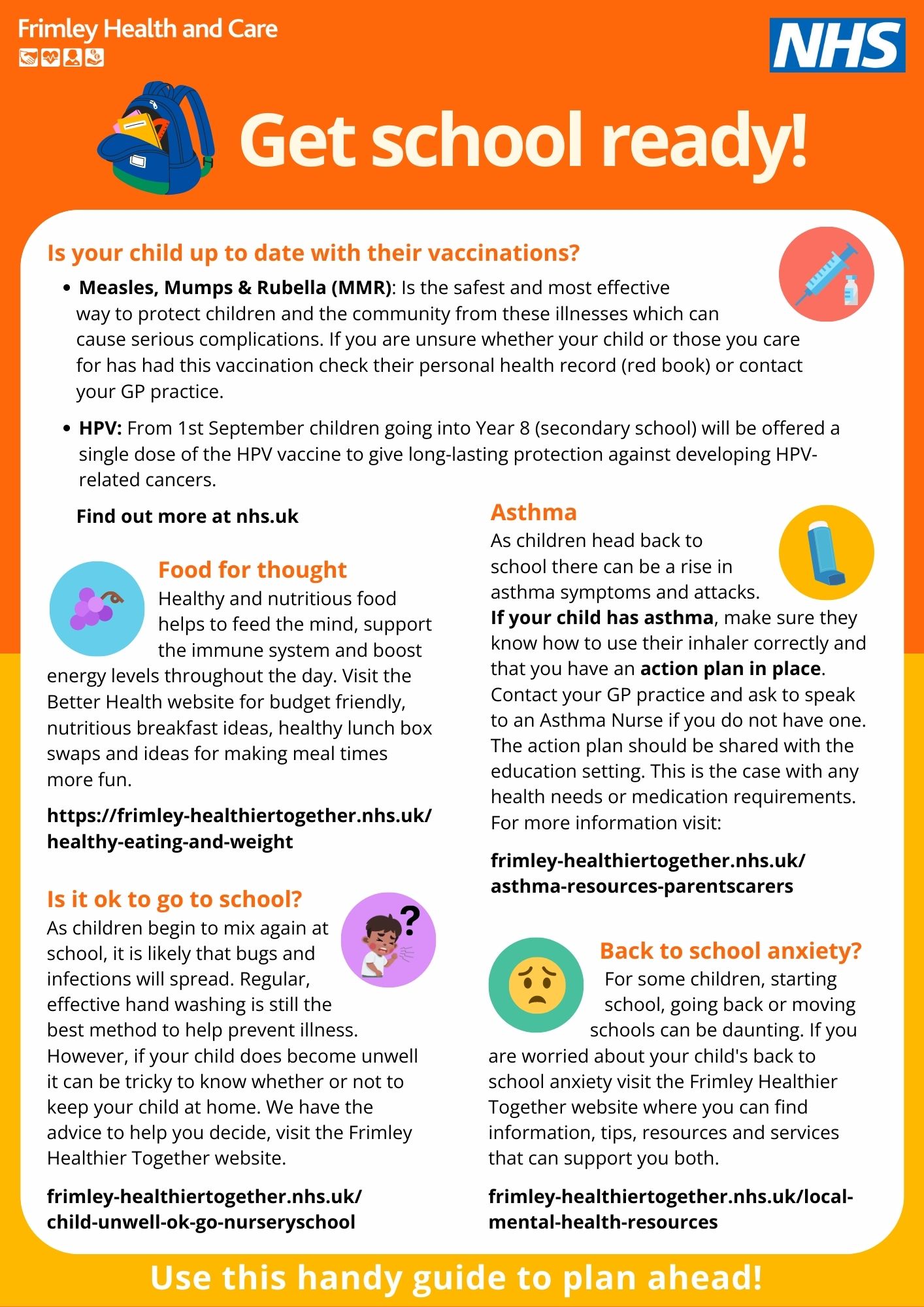
Return to school and college can be a challenging time for children, young people, parents and carers for a number of reasons. We have put together some guidance to help make the transition as smooth as possible.
- Mental health – Supporting parents, children and young people through any anxieties
- Healthy eating – Breakfast and lunch ideas that are healthy but don’t break the bank
- Vaccinations – The importance of making sure they're up to date
- Asthma – The importance of action plans, understanding medications and recognising triggers When to stay home – ensuring any bugs and nasties are stopped in their tracks
Click on the poster on the right to download and save the poster for quick reference and sharing with others and for younger children starting school for the first time visit our helpful pages at Frimley Healthier Together.

For some children the end of the summer holiday and a return to seeing friends each day can’t come soon enough. But for others, just the thought of returning to the classroom can be daunting.
Whether they are starting in a new form, school or college, there can be a lot of stress around this time. From worrying about making friends to having to sit exams, they will all have their own issues and anxieties.
It is important to make sure children and young people are aware the that it is perfectly normal to be feeling stressed or anxious about returning to school, and that Frimley Healthier Together has services and resources that can help and support them https://frimley-healthiertogether.nhs.uk/mental-health/your-local-mental-health-resource
It is important not only to signpost but also to provide children and young people with coping mechanisms to help them manage their anxiety as well as guidance for parents on how to support their child: https://frimley-healthiertogether.nhs.uk/parentscarers/ready-school
It is not just children and young people who can be anxious about their first day at school, it can also be a worrying time for parents. They may be concerned that their child is not ready for school, and that they may need more development. The Frimley Healthier Together website has activities that parents can do with their children to support their child’s development as well as links to the local health visiting service which can provide all the information and guidance needed. https://frimley-healthiertogether.nhs.uk/parentscarers/ready-school
Healthy and nutritious food helps to feed the mind, support the immune system and boost energy levels throughout the day. Visit the Better Health website for budget-friendly, nutritious breakfast ideas, healthy lunch box swaps and ideas for making meal times more fun.
As the World Health Organisation explains, immunisation is a global health and development success story, saving millions of lives every year. Vaccines reduce risks of getting a disease by working with your body’s natural defences to build protection. When you get a vaccine, your immune system responds.
Uptake of most routine childhood vaccinations has been declining over the past 5 to 10 years. It is extremely important that all babies and children receive their routine vaccinations at the right time in order to give them the best start in life. If you are unsure whether your child of those you care for are up to date check their little red book or contact your GP practice as its never to late.
The UK Health Security Agency (UKHSA) and the NHS are encouraging parents and guardians of children aged 1 to 5 years to check that they are up to date with their Measles, Mumps & Rubella (MMR) vaccines and encourage those that may have missed their appointments to come forward as part of their starting school plans. It is the safest and most effective way to protect children and the community from these illnesses which can cause serious complications. Fina out more about MMR at nhs.uk/MMR
It's also worth noting that from 1st September children going into Year 8 (secondary school) will be offered a single dose of the HPV vaccine to give long-lasting protection against developing HPV-related cancers. you can learn more about this https://www.nhs.uk/conditions/vaccinations/hpv-human-papillomavirus-vaccine/
For full guidance on which vaccinations are offered when visit https://www.nhs.uk/conditions/vaccinations/nhs-vaccinations-and-when-to-have-them/
As children head back to school there can be a rise in asthma symptoms and attacks for general advice and guidance on managing asthma in children and young people visit The Frimley Healthier Together Website
Asthma and Lung UK tell us - Every September, there’s a rise in the number of children in the UK who are rushed to hospital due to their asthma. There are a few possible reasons why children are at higher risk of asthma symptoms and asthma attacks after returning to school:
- Lots of children come down with colds when they go back to school – this is one of the biggest triggers for people with asthma
- If your child has a dust mite allergy, being inside more as the weather changes could make their asthma flare up
- Seasonal allergies, such as mould in autumn and pollen in spring and summer could also set off asthma symptoms
- Preventer inhaler routines get easily disrupted over the holidays, so children's airways can be more sensitive to triggers when they go back to school
- Schools are typically deep cleaned over the summer and exposure to cleaning products can trigger asthma attacks
- Going back to school can be an exciting but often daunting time for children. We know that emotions like fear, stress or excitement can trigger asthma symptoms. So can emotional responses like laughing or crying
- For some children, going back to school means being more active, which can trigger asthma symptoms
- Going to secondary school can mean new journeys to school and new subjects like chemistry or design technology, that can increase triggers
How can you prepare?
- The number one priority is to make sure your child is taking their preventer medicine every day, as prescribed. This will help calm the inflammation in their airways and reduce the risk of an asthma attack. You can watch our inhaler videos to make sure that your child is using the right technique. And you can also share the videos with the school too
- Ask your doctor's surgery for an extra reliever inhaler (usually blue), and give it to your child's school. This should preferably be in its original packaging, so the school has the prescription label that comes with it. Send in a spacer too, if your child uses one. You should make sure that you and your child know where this is being stored. It should always be easily accessible and not stored in a locked cupboard
- Download and complete an Asthma School Card with your GP or asthma nurse and give it to the school, so they know what to do if your child gets breathless or starts coughing and wheezing. It will also let them know about your child's triggers
- Make sure your child’s written asthma action plan is up to date and that it has been shared with your child’s school. If your GP or asthma nurse is not yet running face-to-face asthma clinics because of coronavirus, ask for a telephone or video consultation.
- Arrange for your child to have an asthma review, as this will help to pick up any early symptoms. This might be done in person, over the phone or via a video call
- If your child is old enough, you can support them by making sure they can take their inhaler properly by themselves. Watch a video on how to correctly use an inhaler
- Check the school’s policy for needing to tell parents when an inhaler is used. If your child is in secondary school, your child should be telling you when they use their inhaler. If your child is in secondary school, make sure they know to tell an adult if they have had to use their inhaler and it hasn’t helped, or if they’ve used it and their symptoms have come back. It's also good to have a chat with younger children about them telling a grown up when they feel unwell
https://www.asthmaandlung.org.uk/conditions/asthma/child/back-to-school
As children begin to mix again at school, it is likely that bugs and infections will spread. Regular, effective hand washing is still the best method to help prevent illness. However, if your child does become unwell it can be tricky to know whether or not to keep your child at home. We have the advice to help you decide, visit the Frimley Healthier Together website.